

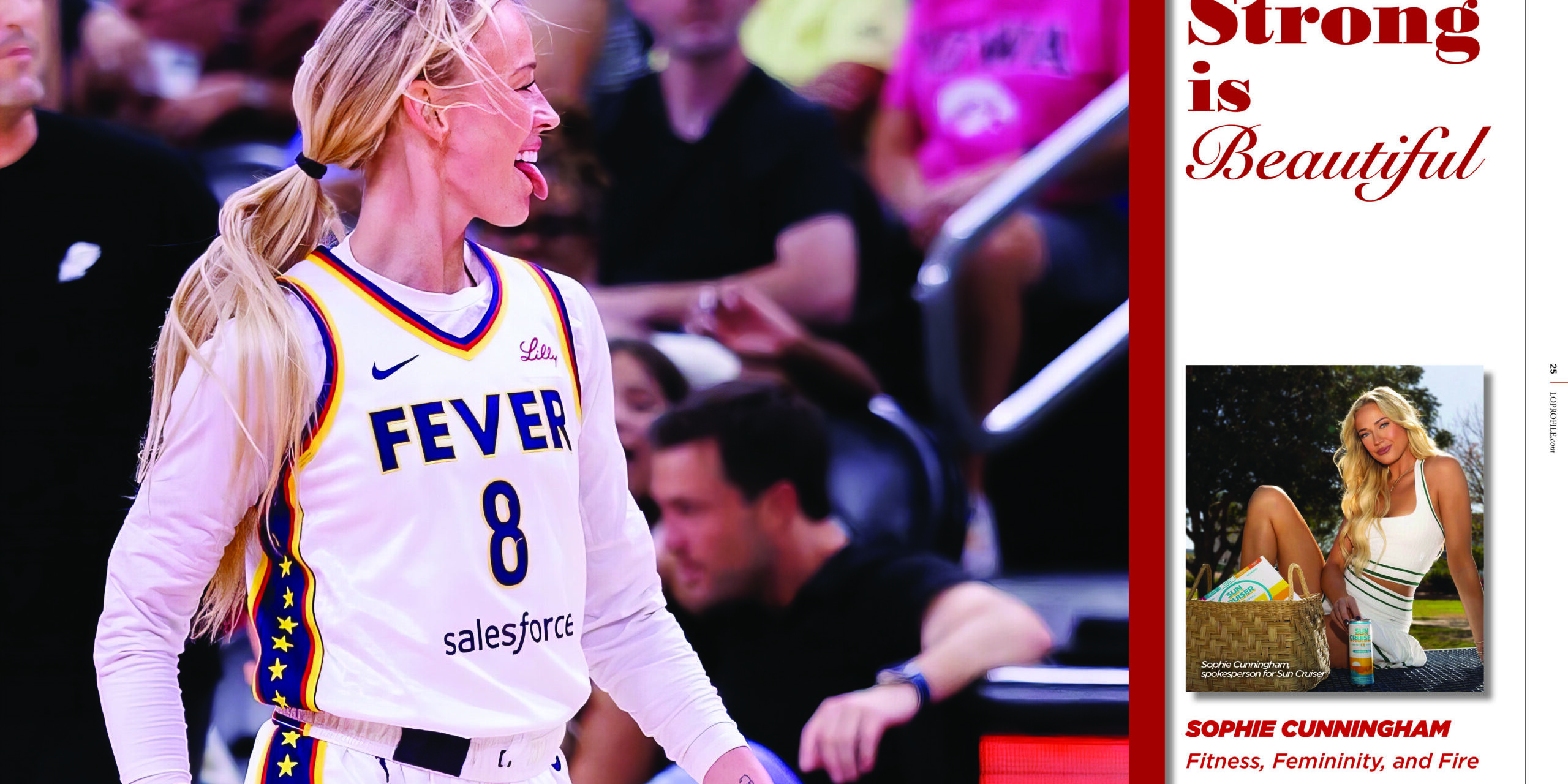
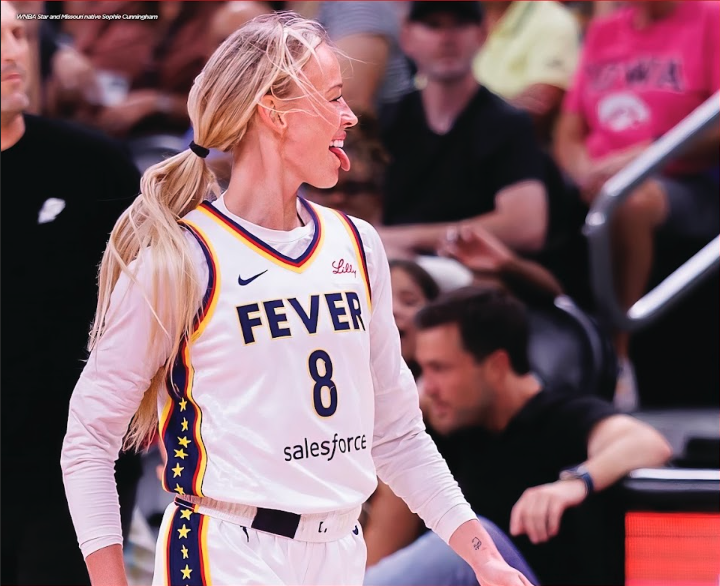
 When Sophie Cunningham walks into a room, she carries a kind of magnetic energy that can only be forged in the heart of the Midwest. She is engaging, fashionable, and undeniably charismatic—beauty in every sense of the word. But step onto a basketball court, and a switch flips. The smile stays. But the fashion turns into physicality, and the girl from Columbia, Missouri, becomes something else entirely—a freight train barreling down the lane, unafraid to crash the boards or protect her teammates at any cost.
 “I’m a freight train. Watch the hell out,” Cunningham says with a laugh, reflecting on a playing style that has made her one of the most popular figures in the WNBA. It is this dichotomy—much like her two favorite colors, pink and black—that defines Cunningham’s rise from a MIZZOU legend to a WNBA veteran now wearing an Indiana Fever jersey. She is the embodiment of the modern athlete: unapologetically feminine, relentlessly physical, and fully herself in both spaces.
The Competitor
To understand Sophie Cunningham, you have to understand what happens when the whistle blows.
 In recent seasons, her national profile has surged—not only because of her shooting range, but because of her role as a protector and tone-setter. After being traded to the Indiana Fever, Cunningham quickly became a vocal presence alongside rookie phenom Caitlin Clark. When opponents tested Clark physically, Cunningham answered—most memorably during a now-viral on-court confrontation that sent a clear message: intimidation would not be tolerated.
For those who know her, the moment came as no surprise.
“I just have that fiery, sassy, confident personality,” Cunningham says. “People who don’t really know me get starstruck. Then I go back home, and everyone’s like, ‘If people really knew who you were, no one would be starstruck.’ I’m like, ‘I tried telling them.’”
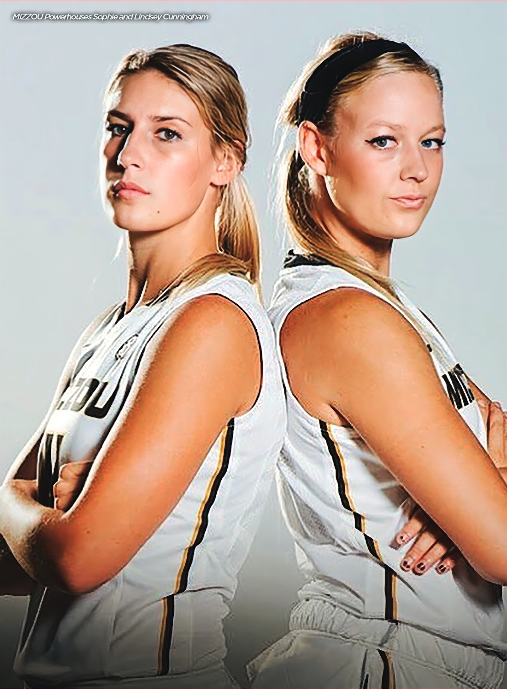
 Missouri fans remember that fire well. During her Mizzou days, Cunningham never hesitated to step into the middle of a moment. In a heated 2018 SEC matchup against South Carolina, words were exchanged after a jump ball, and Cunningham immediately intervened—physically pulling opposing players away from a teammate.
That edge was sharpened long before college arenas and pro crowds.
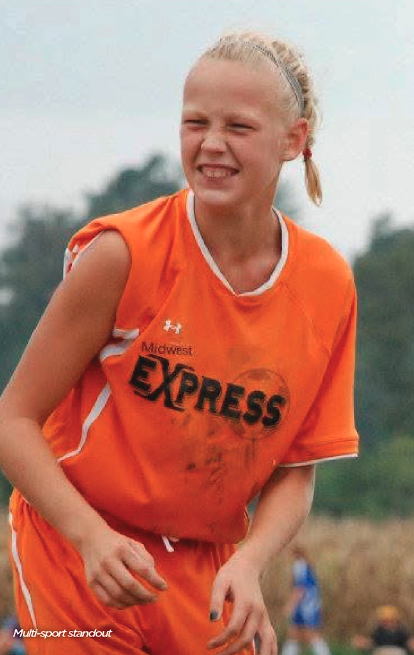
“I was five years old playing with the boys,” she recalls. “My parents had to carry my birth certificate because other parents were like, 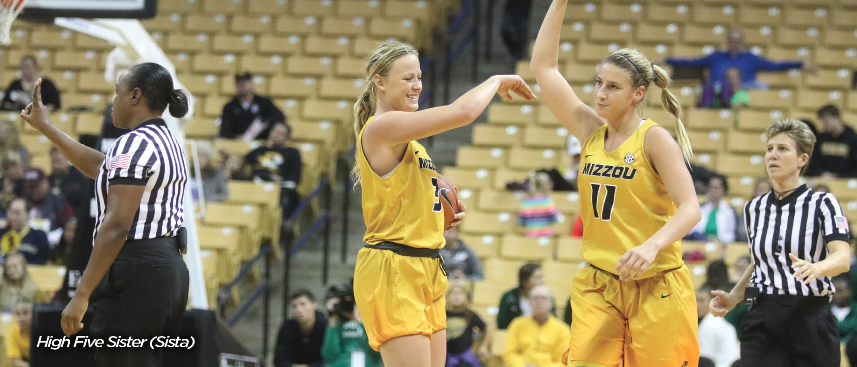 ‘She’s too big. She’s too physical.’ But it’s because I was kicking the boys’ butts.” She grew up knowing her size and height were her biggest superpowers and she was allowed to feel confident about that with excellent role models, like her 5’ 11” mother and 6’ 3” aunt.
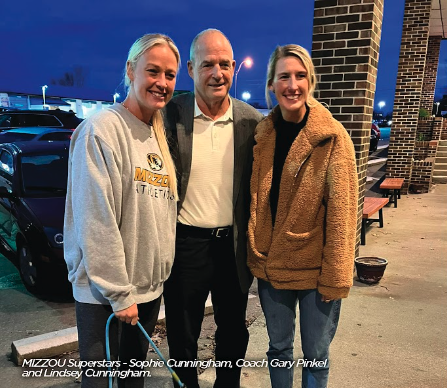 Her reputation as a “badass” is one she embraces—not as bravado, but as acknowledgment of how far women’s sports have come.
“I’ve been on both sides,” she says. “Being in the W when it wasn’t cool, when we were making $25,000 a year—and now being in it when people are intrigued because you’re a woman and you’re strong and confident. Women earned this moment.”
Made in Missouri
 While the rest of the world sees intensity, Missourians understand the source.
Cunningham’s story is deeply rooted in the Show-Me State. Born in Columbia to parents who were both student-athletes at the University of Missouri, she grew up steeped in competition and Tiger pride. By age three, she knew she wanted to play professional sports—she just hadn’t narrowed down which one. Golf, basketball, softball, gymnastics, volleyball, break-away roping—she tried them all.
“I’m a proud Missourian,” she says. “It’s blue-collar. It’s not always fancy. But we outwork people, and we get things done.”
Her upbringing reflected that mindset. Cunningham speaks candidly about a childhood built on accountability, not coddling.
“Lindsey and I had the best childhood. Our family loved hard but weren’t scared to tell us when we were wrong and where we needed to be better. No soft parenting. We got spankings, especially me, and I needed it.”
Unlike many modern athletes shaped by elite pipelines or early fame, Cunningham’s foundation was simple and grounding.
“I didn’t come from fame,” she says. “And I’m totally okay with that. I’m proud of it.”
She credits much of her personality to the women who raised her—especially her grandmother, affectionately known as Mawma.

“She is a pistol,” Cunningham says, laughing. “My mom, my grandma, and me—we’re three peas in a pod. It’s actually scary.”
But in the same breath she credits her dad with being “the best girl dad”, who she might get some of her sass from as “he was able to give as good as he got”.
The confidence Sophie’s family instilled in her led to an unexpected opportunity: an invitation from the Rock Bridge Bruins football coach to step in as placekicker after the team’s starter suffered an ACL tear. Earlier that season, Cunningham had caught the school’s attention when she was pulled from the student section during halftime of the Providence Bowl between Hickman High and Rock Bridge and drilled a 25-yard field goal—one many believed would have been good from 40 yards.
When Rock Bridge lost its kicker, students and fans urged head coach A.J. Ofodile to take a look at Sophie’s leg. She delivered, becoming the first female in school history to score points for the Bruins football team.
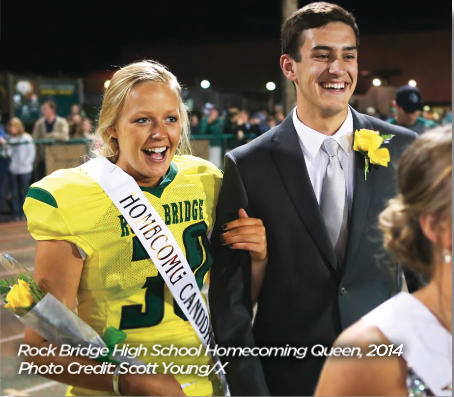
That same season, Cunningham was named Rock Bridge Homecoming Queen—further proof of a well-rounded upbringing that blended confidence, athleticism, and leadership.
Sisterhood and Driveway Battles
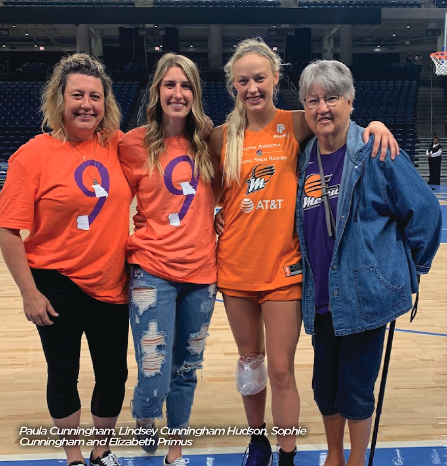 The fiercest competition of Cunningham’s early years wasn’t found in gyms or tournaments—it was in the driveway.
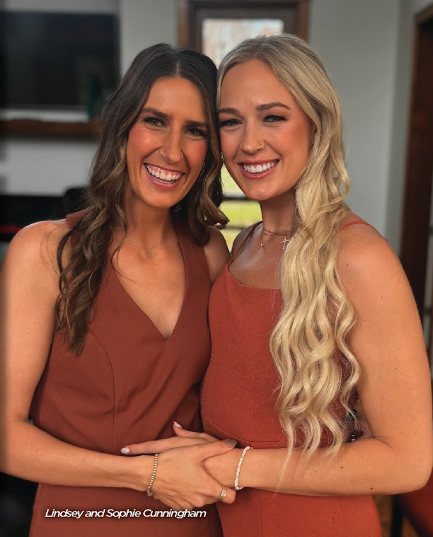
Sophie and her older sister, Lindsey, were inseparable and relentlessly competitive. Every day ended the same way.
“One of us would go inside crying,” she says. “Five seconds later, we were back outside because we wanted to play again.”
Despite the battles, Lindsey remains Sophie’s greatest inspiration.
“She’s the best leader, the best person,” Cunningham says. “I always wanted to be like her—what she wore, her hair, how she treated teammates, her high fives.”
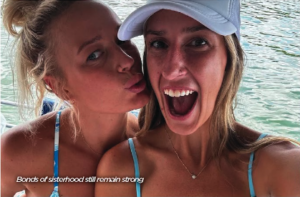
As Sophie’s career accelerated, Lindsey became her anchor. She notes that it couldn’t have been easy when the younger sister gets more of the spotlight, but “We want each other to be the most successful, happiest we can both be.”
“I’m just thankful she embraced all of who I was—as an athlete and as a person,” Cunningham says. “She helped me when I didn’t get things right.”
Today, the sisters are back working together just like their playing days at Rock Bridge High School and MIZZOU, with Lindsey supporting Sophie’s business ventures. Cunningham is quick to note there was never jealousy—though she can’t resist one final jab.
“She could never beat me,” Sophie says, smiling. “That might be why I like her so much.”
A Tiger’s Legacy
 Cunningham’s transition from driveway battles to Rock Bridge and eventually the University of Missouri was destined. As a high school junior, she thought she might be a dual sport athlete at MIZZOU, in basketball and volleyball, but her coach told her that was too much. She chose basketball because she felt more alive on that court, more herself and she loved the physicalness of the game.
At Missouri, she became a program-defining figure.
She started 129 games, averaged 17 points per game, and graduated as the school’s all-time leading scorer. During her senior season, she was the only player in the nation to average more than 17 points while hitting over 80 three-pointers.
But the stats don’t capture the emotional weight of her tenure. She was the hometown hero who stayed. She recalls the intensity of SEC play, specifically the vitriol she faced from rival fanbases like South Carolina. “When you’re 18, 19 years old… it can be hard when like half the country hates you,” she reflects, crediting her sister, Lindsey, for gathering letters from friends and family to help her remember who she was during those storms.
Yet the bond with Mizzou fans never wavered. Years later, the bond with Mizzou fans remains unbreakable. “Seeing people up in the crowd… familiar faces who know what Murry’s is, they know what Shakespeare’s is… that’s what makes this journey so special,” she says.
And yes, she has an opinion on Shakespeare’s Pizza.
“I actually love the thin crust way more than what they’re known for,” she laughs, admitting she keeps a stack of Shakespeare’s cups in her cupboard.
Beauty Behind the Beast

Off the court, Sophie Cunningham is dismantling the stereotype that an elite competitor cannot be feminine. She is part of a generation of players who are reclaiming “girly” things without sacrificing their athletic credibility.
“It’s okay to work hard. It’s okay to sweat. It’s okay to have a black eye,” she says. “You can do all the things the boys do and still be feminine.”
Her routine is a testament to this balance. While she spends four to five hours a day on rehab (following a recent MCL surgery), weights, and conditioning—now incorporating Pilates to maintain her figure and agility—she is equally disciplined about her self-care. “I really do think you staying true to yourself is like the best weapon that you can have,” she says.
The Professional Grind
Drafted 13th overall by the Phoenix Mercury in 2019, Cunningham quickly learned that professional basketball demands more than talent.
“

There’s a lot of sacrifice,” she says. “You miss weddings, births, family anniversaries. It gets lonely—and no one really talks about that.”
To navigate the mental toll, Cunningham turned to sports psychology.
“I meet once a week with my guy,” she says. “It completely changed how I approach my job.” For her, mental training isn’t damage control—it’s a competitive advantage.
“If you don’t get your mind right, it’s so easy to spiral,” she says.
Looking ahead, she’s intrigued by new professional opportunities in women’s basketball, having signed to play in the new “Project B” league. The idea of playing during the winter, making “really, really good money,” and having time off to experience the world appeals to her desire for balance.
She also has gained broadcasting experience as “Spicy Sophie” doing commentary for the Phoenix Suns making broadcasting a possible future endeavor after she leaves the game.
Lake Life and Legacy

Despite stops in Phoenix and Indianapolis, Cunningham’s heart often drifts back to the Lake of the Ozarks.
Her aunt and uncle’s lake house was a gathering place—crowded weekends with dozens of friends, boat rides, laughter, and long summer nights.
“I’m hoping to actually get a place at the lake, too,” she reveals, hinting at a desire to keep those traditions alive for the next generation. She even harbors a “snowbird” dream: owning a ranch with animals while maintaining a warm-weather getaway.
For Cunningham, relaxation means disconnecting from the grind.
“I will be at the pool,” she says of her downtime. “I just feel better when I’m tan… It just checks off a lot of boxes”.
Her drink of choice whether at the pool or the Lake? A “Sun Cruiser,” a premixed iced tea, lemonade and vodka combo she describes as “dangerous” because they taste just like lemonade.
Beyond basketball, Cunningham is committed to impact. She has supported the Ronald McDonald House, after working with the program as a McDonald All-American in high school, and veterans’ organizations, often hosting families at games through “Cunningham’s Corner” while playing in Phoenix.
When she thinks about legacy, it isn’t about points or stats.
“I want fans to remember how fun the games were,” she says. “How I treated them. How I made them feel.”
In a world that still tries to make women choose—beauty or beast, softness or strength—Sophie Cunningham proves you can be all of it. You can wear lip gloss and throw elbows. You can be a global name and still care deeply about a slice of pizza from home.
You can be a legend—and still just be Sophie from Columbia.
And for Missouri, that is exactly who she is.