
So, the decision has been made – becoming a golfer. Congratulations on this choice and your wise investment in yourself. Golf is an excellent way to improve physical health, socialize with friends, and, hopefully, strengthen mental well-being (though that’s debatable). Now, it’s time to acquire a set of clubs, and the process can feel overwhelming. There are many factors to consider, including your budget, the type of shaft flex, club head, and grips. Fortunately, experts are available to guide the way.
Step 1: Determine Your Budget
First, decide on a budget. It’s easy to spend a lot of money on high-end, brand-new clubs, but Larry Salsman, a PGA Master Professional at Osage National Golf Club, recommends purchasing used clubs. “Something within the last seven years. Golf clubs that are too old don’t have the forgiveness that today’s clubs offer. Forgiveness is key. Callawaygolfpreowned. com is a great place to find used clubs. The best part about buying used is that you don’t lose much of the money when you go to resell them.”
Step 2: Understand the Basic Set of Clubs
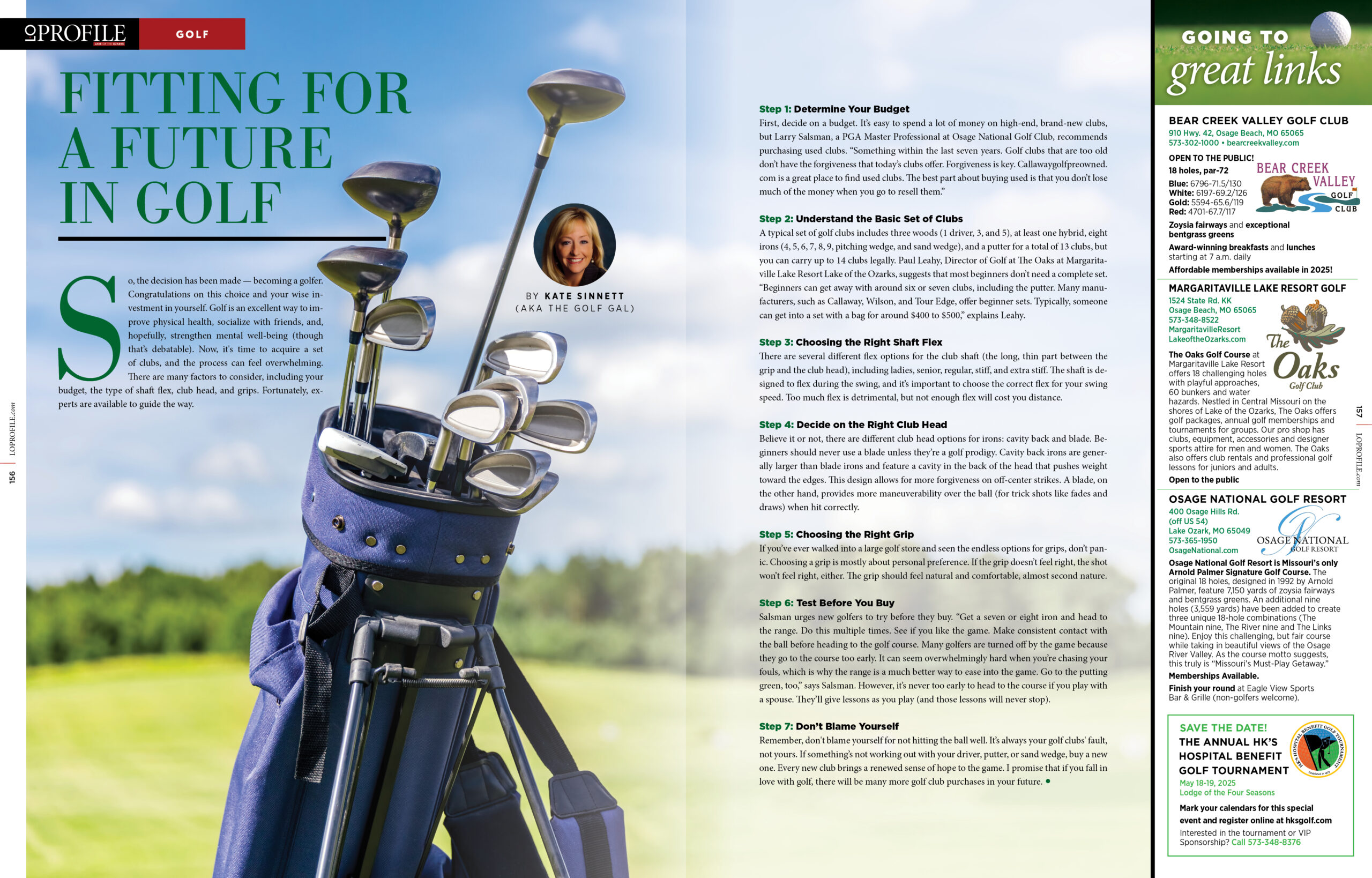
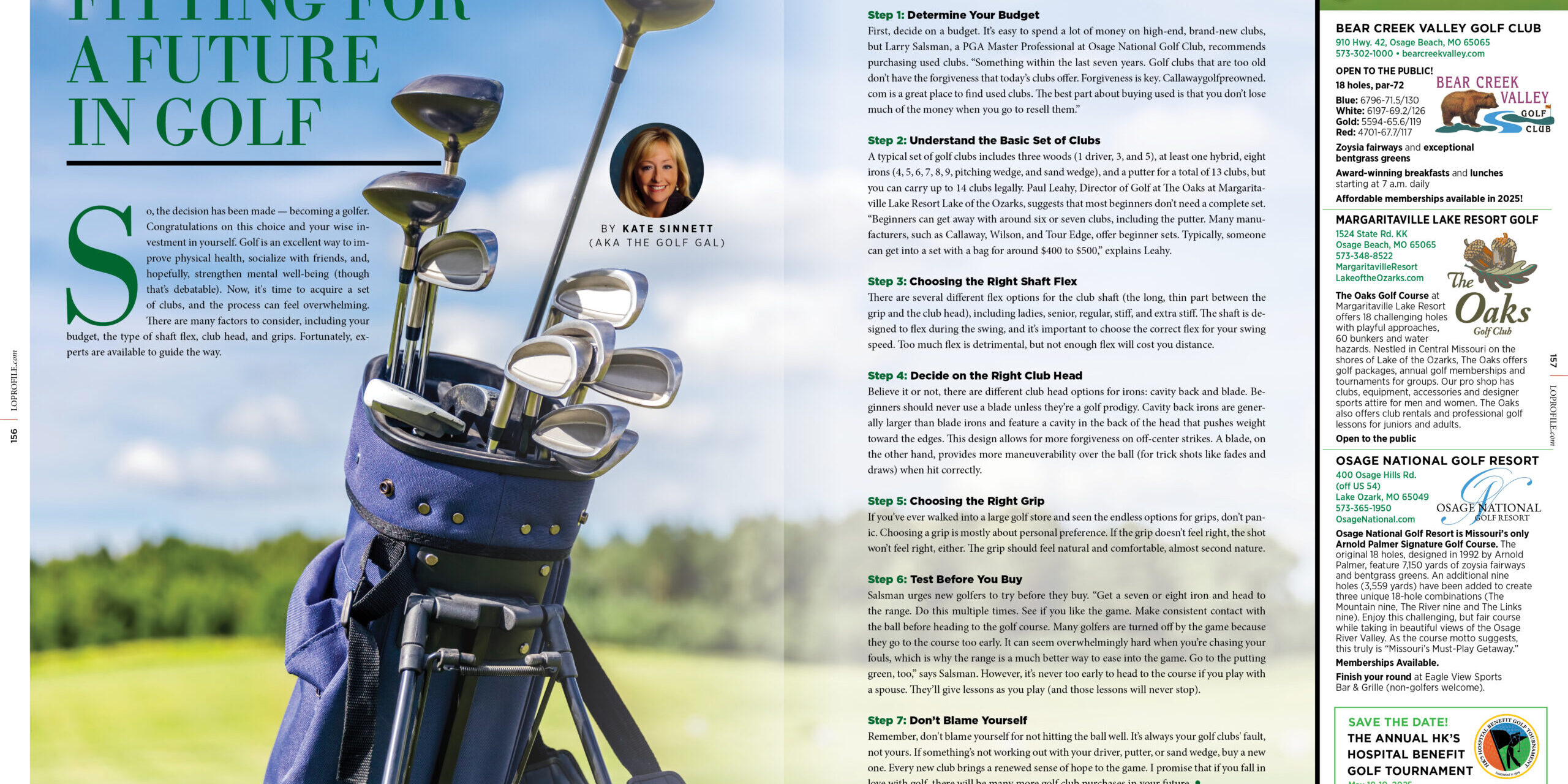
A typical set of golf clubs includes three woods (1 driver, 3, and 5), at least one hybrid, eight irons (4, 5, 6, 7, 8, 9, pitching wedge, and sand wedge), and a putter for a total of 13 clubs, but you can carry up to 14 clubs legally. Paul Leahy, Director of Golf at The Oaks at Margarita-ville Lake Resort Lake of the Ozarks, suggests that most beginners don’t need a complete set. “Beginners can get away with around six or seven clubs, including the putter. Many manu-facturers, such as Callaway, Wilson, and Tour Edge, offer beginner sets. Typically, someone can get into a set with a bag for around $400 to $500,” explains Leahy.
Step 3: Choosing the Right Shaft Flex
There are several different flex options for the club shaft (the long, thin part between the grip and the club head), including ladies, senior, regular, stiff, and extra stiff. The shaft is designed to flex during the swing, and it’s important to choose the correct flex for your swing speed. Too much flex is detrimental, but not enough flex will cost you distance.
Step 4: Decide on the Right Club Head
Believe it or not, there are different club head options for irons: cavity back and blade. Beginners should never use a blade unless they’re a golf prodigy. Cavity back irons are generally larger than blade irons and feature a cavity in the back of the head that pushes weight toward the edges. This design allows for more forgiveness on off-center strikes. A blade, on the other hand, provides more maneuverability over the ball (for trick shots like fades and draws) when hit correctly.
Step 5: Choosing the Right Grip
If you’ve ever walked into a large golf store and seen the endless options for grips, don’t pan-ic. Choosing a grip is mostly about personal preference. If the grip doesn’t feel right, the shot won’t feel right, either. The grip should feel natural and comfortable, almost second nature.
Step 6: Test Before You Buy
Salsman urges new golfers to try before they buy. “Get a seven or eight iron and head to the range. Do this multiple times. See if you like the game. Make consistent contact with the ball before heading to the golf course. Many golfers are turned off by the game because they go to the course too early. It can seem overwhelmingly hard when you’re chasing your fouls, which is why the range is a much better way to ease into the game. Go to the putting green, too,” says Salsman. However, it’s never too early to head to the course if you play with a spouse. They’ll give lessons as you play (and those lessons will never stop).
Step 7: Don’t Blame Yourself
Remember, don’t blame yourself for not hitting the ball well. It’s always your golf clubs fault, not yours. If something’s not working out with your driver, putter, or sand wedge, buy a new one. Every new club brings a renewed sense of hope to the game. I promise that if you fall in love with golf, there will be many more golf club purchases in your future.